#scholcomm
19 posts · Last used 20d
Replying to
Update. "Mixed-gender teams are more likely to face #retractions than all-male or all-female teams, while individual authors are less prone to retractions…Male-led publications are often retracted for serious ethical violations, such as data falsification and plagiarism, while female-led publications primarily face procedural errors and updates in rapidly evolving fields. Promoting women to positions of responsibility in mix-collaborations may not only advances gender equity but also the accuracy of the scientific record."
https://doi.org/10.1162/qss_a_00353#Gender #ScholComm
Replying to
Update. New study: In the social sciences, "male editors-in-chief outnumber females across most fields (66.67%), countries (76.60%), and affiliations (63.16%)."
https://journals.plos.org/plosone/article?id=10.1371/journal.pone.0317931
#Gender #ScholComm
Replying to
Update. "Since 2017, the #UK has mandated organisations employing more than 250 people to publicly report their annual #gender #PayGap…Every science publisher pays men more than women. In 2024, the lowest median pay gap favouring men was 9.5% (#SpringerNature), followed by #Sage (13.3%), #Wiley (17.7%), and #Informa (formerly Taylor & Francis) (22.7%). #Elsevier remains an outlier in the magnitude of its gender pay gap and in the lack of progress. Eight years ago Elsevier stood out among publishers, with a median pay gap in 2017 of 40.4% in favour of men over women in its UK business…Elsevier’s median pay gap for 2024 is 32.8%, maintaining its position as worst performer among peers over all eight years of mandatory reporting."
https://doi.org/10.1371/journal.pgph.0004673#Publishers #ScholComm
Replying to
New study: "More women-led papers receive at least one media mention in women-underrepresented fields, but they are cited less frequently across all fields. Women authors are underrepresented in national outlets and are more often reported by liberal media. Sentiment analysis shows that men-led papers are more often associated with positive sentiment in news text, while women-led papers elicit more negative sentiment."
https://journals.sagepub.com/doi/abs/10.1177/10755470251360187#Gender #GenderBias #ScholComm
Replying to
Update. "Women are significantly underrepresented among highly cited scholars globally (0.255 women per man) and receive fewer citations and have lower h-indexes than men in most regions and disciplines. However, after controlling for productivity and career length, female scholars are cited more than men in the pooled sample, Asia, Europe, and in two fields (natural sciences and exact sciences/physics). Despite this, women’s h-index remains significantly lower than men’s in all regions except Africa and South America, and in all fields except social sciences."
https://journals.plos.org/plosone/article?id=10.1371/journal.pone.0334690#Gender #GenderBias #ScholComm
Replying to
Update. "Authors with very feminine and masculine first names respectively get a lower and higher share of citations for every article published, irrespective of their contribution role."
https://arxiv.org/abs/2512.08219#Gender #GenderBias #ScholComm
Replying to
Update. "In male-dominated fields, women have significantly broader research interests than men, while this gap diminishes and reverses in more gender-balanced fields. Although broader publication trajectories help women increase publication output, this strategy carries steeper citation penalties for women than for men. The results suggest that academic fields act as sites of inequality production, channeling women toward research patterns that boost immediate productivity while undermining long-term scholarly influence."
https://journals.sagepub.com/doi/pdf/10.1177/23780231251396273
#Gender #GenderBias #ScholComm
Replying to
Update. In the field of oil pollution research, "female authors accounted for about 32% of the total authors…were significantly underrepresented in most of the African countries [and in] the UK and Norway…Gender variation in oil pollution publications was discovered to be influenced by religion in Africa; Islam had the mean highest rank when compared with Christianity."
https://doi.org/10.4314/jasem.v29i11.22
#Gender #GenderBias #ScholComm
Replying to
Update. "We conduct a comprehensive comparison between peer-review scores and citation-based metrics across various scientific fields [in Italy]…While both evaluation methods exhibit sex bias, peer review systematically penalizes women more severely than citation-based metrics."
https://www.sciencedirect.com/science/article/pii/S1751157725001245
#Gender #GenderBias #ScholComm
Replying to
Update. A letter to the editor about a study I posted to this thread 11/23/25: "The suggestion that [the lower #retraction rate for women] is because male researchers undergo more scrutiny, propose bolder ideas and lead larger and more dynamic teams than do female researchers implies that male scientists are better at science. As female scientists, our lived experience points to alternative explanations: elevated rigour and scientific integrity by female scientists or more critical peer review of female-led manuscripts."
https://www.nature.com/articles/d41586-026-00120-y
(#paywalled)
#Gender #GenderBias #ScholComm
Replying to
Update. "By analyzing all articles indexed in the PubMed database (>36.5 million articles published in >36,000 biomedical and life sciences journals), we show that the median amount of time spent under review is 7.4%–14.6% longer for female-authored articles than for male-authored articles."
https://doi.org/10.1371/journal.pbio.3003574#Gender #GenderBias #ScholComm
Replying to
Update. "Citation counts [for female authors] are on average 5.5% lower than those of comparable male authors…Papers produced by all-female teams receive 56.7% fewer citations than those by all-male teams, while mixed-gender teams achieve a 30.9% citation advantage."
https://ceur-ws.org/Vol-4155/paper10.pdf#Gender #GenderBias #ScholComm
Replying to
Update. Many studies look at the acceptance rate for articles by women at high-impact journals. This one looks at the submission rate, and finds that women submit significantly fewer articles to these journals than men. (The percentages differ by field.) When asked why, the most common response was that "they were advised not to."
https://elifesciences.org/articles/90049#Gender #GenderBias #ScholComm
Vladimir Moskovkin proposes an interesting "reform model for scholarly communication that combines elements of centralized access —based on adapting the Soviet VINITI experience to the digital environment— with decentralized Diamond Open Access platforms."
PS: This is the first time I've seen anyone draw the Soviet #VINITI model into #OpenAccess / #ScholComm discussions.
Here's some background on the model, if it's new to you.
https://en.wikipedia.org/wiki/VINITI#Centralization #Decentralization #DiamondOA
When #AI tools hallucinate citations, their made-up author names are not random. "We show that #LLMs do not merely default to high-probability individual names when generating fictional experts: they produce correlated character ensembles, pairs and trios [of co-authors] whose co-occurrence rates far exceed chance and are consistent across independent generations."
https://arxiv.org/abs/2606.02184
They fool people and tools:
"We identify 1,655 ghost-authored records claiming nonexistent journals with fabricated publication dates…Server-side #DataCite timestamps prove deliberate backdating…These carry real #DOIs…making them harvestable by any scholarly aggregator that ingests DOI metadata."
#Citations #Hallucinations #ScholComm
Passionate about open science and open data? Join the team at Dryad!
We're searching for a remote Partnership Development Manager to help build our network of partner societies, publishers & institutions.
https://bit.ly/4xeizDC
#publishingjobs #scholcomm #scholcomms #opendata #openscience #openaccess #openresearch #biology #science
New study: "We show…that research assessment is driven more by differences between evaluators than by difference in the evaluated research."
https://arxiv.org/abs/2607.09783
#Academia #Assessment #PeerReview #ScholComm #Universities
Replying to
Update. This article in Nature makes the case that reusing #OpenData for new purposes is a good solution for "cash-strapped and early-career researchers" who don't have the means to generate their own.
https://www.nature.com/articles/d41586-026-00434-x
True enough. But it undervalues the utility of past data for all relevant new projects, even well-funded new projects. The present thread gives some examples. Open data are not only, and not even primarily, for the indigent. They're for the savvy, those who notice their relevance, regardless of means.
#Data #ECR #Funding #OpenScience #Reuse #ScholComm
Boosted by @kkarhan@jorts.horse
Replying to
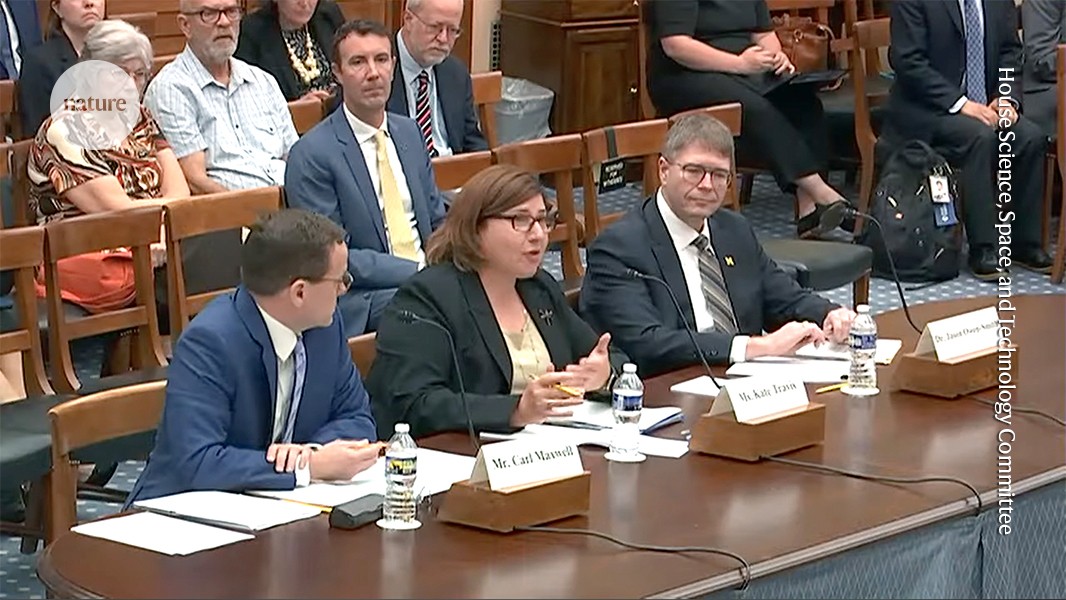
Update. The passage in the #Trump budget criticizing expensive #subscriptions and #APCs (previous post, this thread) triggered a debate in the House of Representatives.
"US lawmakers intensify scrutiny of scientific-publishing practices."
https://www.nature.com/articles/d41586-026-01251-y
"From ‘paper mills’ that sell authorships on fake or low-quality research papers to the costs associated with open-access publishing, US lawmakers are paying increasing attention to widely debated issues in scientific publishing. In a rare show of unity, members of the US House of Representatives from both sides of the political aisle agreed at a hearing that these issues deserve more attention from government — but there was less unity on what the solutions should be."
#OpenAccess #Publishing #ScholComm
You've seen all posts